
EAM Jaishankar's mission is aimed at strengthening India's strategic autonomy in a complex international environment, observes Ambassador M K Bhadrakumar.
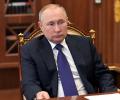
Russia proceeds "from the postulate, a negotiated solution to the Palestinian-Israeli conflict has no alternatives," said Putin while speaking at the Commonwealth of Independent States summit in Bishkek, Kyrgystan on Friday.

Modi is visiting the African country from August 22 to 24 at the invitation of South African President Cyril Ramaphosa. South Africa is hosting the first in-person summit of BRICS comprising Brazil, Russia, India, China, and South Africa, since 2019.
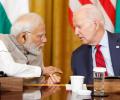
'Every type of deal that US government officials were privately indicating 'hope' to have included a few months back made it in.'

The Delhi government will extend its beautification efforts to all parts of the national capital after G20 designated parts of the city witnessed a facelift for the international summit, cabinet ministers Atishi and Saurabh Bharadwaj announced on Monday.

India and Saudi Arabia on Monday called on states to reject the use of terrorism against other countries and prevent access to weapons, including missiles and drones, to commit acts of terror.

The World Economic Forum's five-day annual summit began in Davos this evening amid hopes of recovery in global economy and a time of renewed terror threats after recent strikes in France and other parts of globe.

As the COVID-19 pandemic continues to unravel in various parts of the country, the World Economic Forum on Monday announced the cancellation of its high-profile annual meeting for 2021 after postponing it at least twice along with two changes in venue. The next annual meeting will now take place in the first half of 2022, while the location and date would be determined after assessing the situation later this summer, said the Geneva-based organisation that has been hosting a yearly congregation of the rich and powerful from across the world in Swiss ski resort town of Davos for 50 years. This year's Davos summit was originally scheduled for January 2021, but was later moved to a different location in Switzerland, Lucerne, and then to Singapore with an August 2021 schedule.

Modi will hold several bilateral meetings with the leaders of the SCO member countries including China's Xi Jinping.
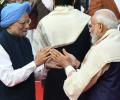
While Narendra Modi spent fewer days abroad than his predecessor -- 275 days versus Dr Singh's 306 - he has travelled more widely than any other Indian PM.
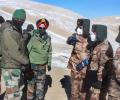
Lou also spoke about China's tensions with neighbouring countries without directly mentioning the eastern Ladakh border standoff with India since May 2020 which resulted in the Galwan Valley clash in June of that year.

Prime Minister Narendra Modi on Thursday left for the Uzbek city of Samarkand to attend the Shanghai Cooperation Organisation (SCO) summit that will also see the participation of Russian President Vladimir Putin, Chinese President Xi Jinping and Iran's Ebrahim Raisi among other top world leaders.
Modi is also expected to hold bilateral meetings on the sidelines of the summit, including with Putin, and Uzbek President Shavkat Mirziyoyev among other leaders.

His remarks without naming any country came against the backdrop of tension between India and Pakistan after New Delhi revoked Jammu and Kashmir's special status.

'India needs to be cautious that its differences with Pakistan do not obstruct SCO's functioning,' says Sana Hashmi.

South Africa's Deputy International Relations and Cooperation Minister Marius Fransman said this would give a major boost to some of the development needs of these countries.

Prime Minister Narendra Modi on Friday met Israeli President Isaac Herzog and underscored India's support for an early and durable resolution of the Israel-Palestine issue through dialogue and diplomacy.
"Reports of PM Modi not meeting Putin due to nuclear threat is baseless. The meeting is not taking place due to scheduling issues," sources told ANI.
The Shanghai Cooperation Organisation (SCO) will hold its first in-person summit in Samarkand in Uzbekistan on Thursday after two years, shaking off Covid fears and providing a rare opportunity for all its eight heads of state to meet on the sidelines of the event to have face-to-face talks on pressing global and regional issues of common concern.

China was forthcoming and supportive of international civil nuclear energy cooperation with India as the two countries affirmed their readiness to take their strategic and cooperative partnership to a new level at the ASEAN summit in Singapore on Wednesday.

With India's G20 presidency ensuring several tangible outcomes, world leaders at the two-day summit in New Delhi hailed Prime Minister Narendra Modi for his 'decisive leadership' and for championing the voice of the Global South, sources said on Sunday.

Argentina, Egypt, Ethiopia, Iran, Saudi Arabia and the United Arab Emirates have been invited to join the grouping.
The United States on Friday expressed concern over the departure of Canadian diplomats from India and said that it expects New Delhi to uphold its obligations under the 1961 Vienna Convention on Diplomatic Relations.

'...to bring the Global South and others to the negotiating table on the basis of Gandhi's non-violence so that we can leave a safer world for our children.'
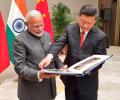
'Xi's meeting with Modi in the southern Indian city of Chennai on Friday and Saturday is expected to focus more on the two countries' historical and present differences, and how to move beyond them to realise their cooperation potential'
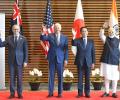
Chinese and Russian warplanes on Tuesday conducted joint air patrols over the Sea of Japan, the East China Sea and the West Pacific Ocean as the leaders of Quad held their in-person summit in Tokyo, in an apparent attempt to send a message of unity between Beijing and Moscow.

Modi is also scheduled to hold a bilateral meeting with Xi on Tuesday.

An MoU on sharing hydrological information of the Brahmaputra River by China to India and another pact on amendment of the protocol on phytosanitary requirements for exporting rice from India to China to include non-Basmati rice were signed after the Modi-Xi talks in the eastern Chinese port city.

Though the two-day SCO Council of Foreign Ministers' meeting began at the Taj Exotica Resort in Benaulim on Thursday evening with a reception hosted by Jaishankar, the main deliberations took place on Friday.
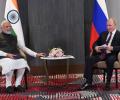
The phone conversation came days after it emerged that Modi will not be travelling to Russia for the annual India-Russia summit this year.

The 'Missing link in India's Act East Policy', as India's former foreign secretary Shyam Saran calls it, needs to be filled sooner rather than later, says Dr Rahul Mishra.

Russian Defence Minister Sergei Shoigu and his counterparts from Uzbekistan and Kyrgyzstan are also attending the meeting to be chaired by Rajnath Singh.

The leaders said they stand for adherence to international law, peaceful resolution of disputes and respect for principles of the UN Charter, including territorial integrity and sovereignty of all states.

In his opening remarks at a ministerial meeting in Tokyo of the Quadrilateral coalition, also known as 'Quad', External Affairs Minister S Jaishankar said India remained committed to a rules-based world order, respect for territorial integrity and sovereignty, and peaceful resolution of disputes.

Emphasising the importance of sustaining food and energy security, the G20 leaders called for the "cessation of military destruction or other attacks on relevant infrastructure".

The members of the grouping made it clear that they were against the use or threat of use of nuclear weapons and sought "peaceful resolution of conflicts."

Except for Pakistan, the defence ministers of all other member countries attended the meeting in person. It is learnt that the Pakistani representative joined the deliberations virtually.

Modi was expected to arrive in Wuhan in the evening on April 26 and join Xi in the informal summit at a picturesque location the next day.

'Clearly, the warming of ties can be a 'win-win' for India and China,' says Ambassador M K Bhadrakumar.
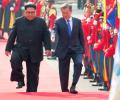
'Much depends on Moon's persuasive skill to make both Trump and Kim shed some of their rigidity and be flexible to accommodate contrarian viewpoints,' says Dr Rajaram Panda.
 © 2026 Rediff.com - Advertise with us - Disclaimer - Privacy Policy - Sitemap - Feedback - About us - Terms of use - Grievances